

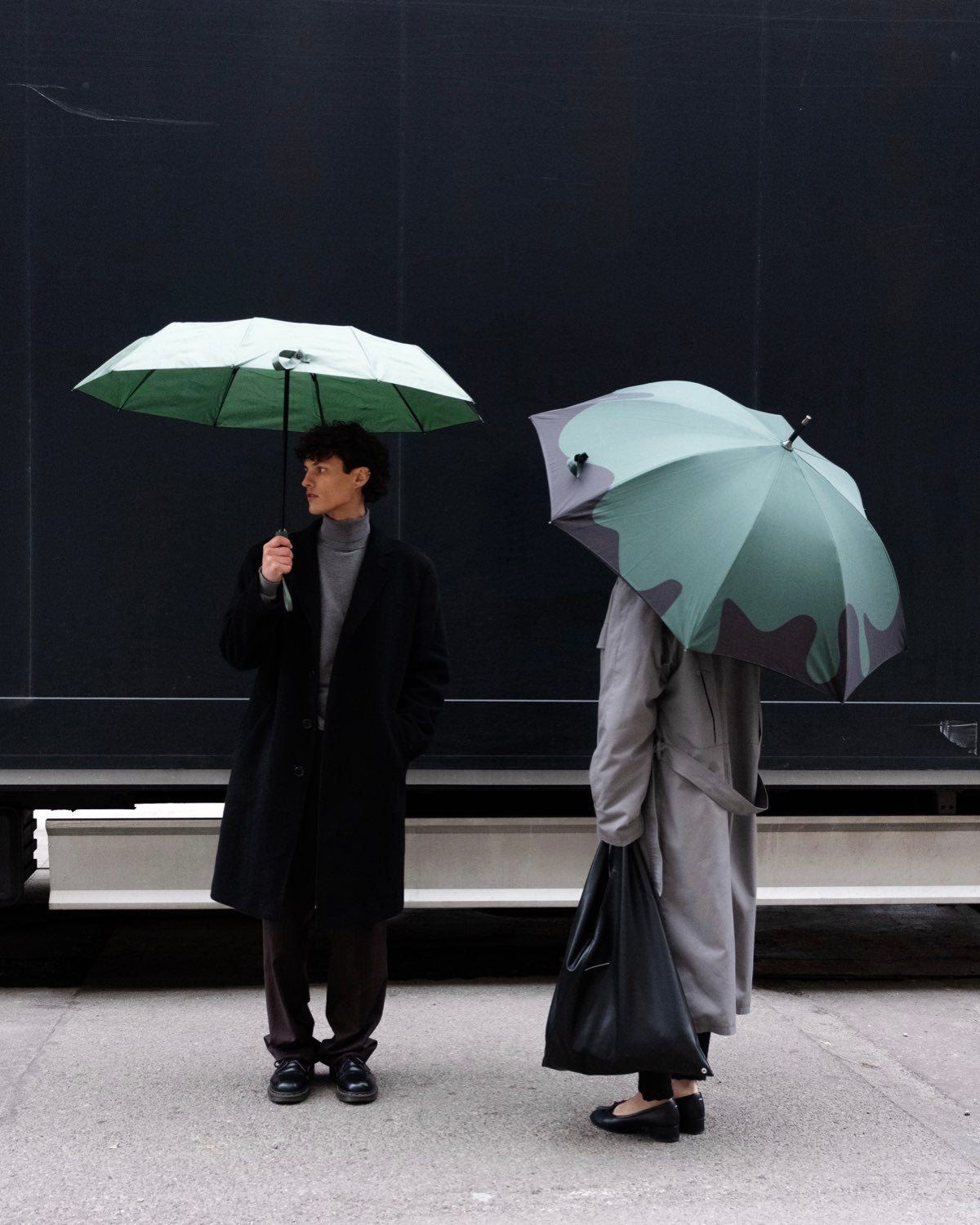
Rain as a Ritual: Embracing the Quiet Moments
Rain alters a city before it alters our plans. Asphalt darkens. Familiar outlines appear in the street as reflections. Sound becomes softer, movement more deliberate and even an ordinary route begins to feel different.
We often speak of bad weather as if it were an interruption to the day itself. Yet rain is, first of all, a change in conditions. It asks us to pay closer attention: to the ground beneath us, to the wind, to our own movement and to the objects we carry.
A different rhythm
A rainy day follows a different rhythm.
We look at the sky, reach for an umbrella and open it before stepping outside. We find a sheltered place to close it again. Later, we leave it to dry. These actions are small and usually unremarkable. That is precisely why they can become a ritual.
A ritual does not have to be ceremonial. It can simply be a familiar sequence carried out with attention.
Rain does not necessarily interrupt everyday life. It changes its form.

An object between us and the weather
The umbrella holds a particular place within this sequence. It does not remove the weather. It creates a measured, moving space of shelter that allows us to continue through it.
Because an umbrella is used so directly, its details matter: how it feels in the hand, how naturally it opens and closes, and how its form, materials and construction behave in motion.
A well-considered object does not need to demand constant attention. It performs its purpose reliably and accompanies the moment without dominating it.
This understanding is also part of our ethos at Sapor. We do not see an umbrella as a temporary solution to bad weather. It is an everyday object worthy of care and consideration precisely because it accompanies us through ordinary, recurring moments.

Experiencing rain without romanticising it
“Embrace the rain” does not mean pretending that wet clothes, strong winds or a missed bus are pleasant. It means accepting the conditions of a day without dismissing the day itself.
Rain changes light, sound and movement. It alters surfaces and can make even a familiar street appear new for a moment. Those changes are easy to miss when our only intention is to escape the weather as quickly as possible.
Perhaps a different relationship with rain begins there: not with enthusiasm for every forecast, but with a willingness to meet the weather as it is.
With one step outside. With a carefully chosen object in hand. And with attention to a moment we might otherwise have overlooked.
Embrace the rain.
Article updated and published again on 20.08.2026