How Wind-Resistant Can an Umbrella Be? What Stability Really Means
An open umbrella has a large, tensioned surface. What provides protection from rain becomes an exposed area in the wind. Gusts rarely meet the canopy evenly. Their direction and strength can change within moments, placing simultaneous pressure on the ribs, joints, shaft, fabric and attachment points.
The honest answer to the question of a stormproof umbrella is therefore simple: unlimited storm resistance does not exist. No portable umbrella can withstand every wind speed and every possible gust.
A good umbrella is not defined by making an unrealistic promise against the weather. What matters is how carefully its construction receives, distributes and, where necessary, yields to the forces acting upon it.
Why Wind Places Such Pressure on an Umbrella
The force exerted by moving air does not increase evenly with wind speed. In simplified terms, aerodynamic drag increases with the square of velocity. If the wind speed doubles, the resulting load can be approximately four times greater under otherwise equal conditions.
A wind that initially appears manageable can therefore place far greater pressure on the canopy within a matter of seconds. Changing gusts, turbulence between buildings and sudden shifts in direction are particularly demanding.
An umbrella is not merely pushed backwards. Its canopy can be lifted, twisted sideways or caught from underneath. This creates different tensile, compressive and torsional forces throughout the frame.
The underlying physics is described by sources including NASA’s drag equation. For an umbrella, the next question is how its construction manages those forces.
Stability Does Not Mean Maximum Rigidity
A completely rigid frame may initially sound particularly resistant. In practice, however, an inflexible construction can concentrate a load at individual points. Once the limit of a component is exceeded, it may bend permanently or break.
Controlled flexibility takes a different approach. A rib can yield slightly under pressure and then return to its original shape. The force is not absorbed exclusively at one rigid point.
This does not mean that the most flexible umbrella is automatically the best. Excessive movement would make the canopy unstable and difficult to control. Resilience emerges from the balance between stability and flexibility — and from the precise coordination of every component.
The Complete Construction Matters
The wind resistance of an umbrella cannot be reduced to a single feature. Neither the material nor the number of ribs answers the question on its own.
Several elements must work together:
Ribs and Stretchers
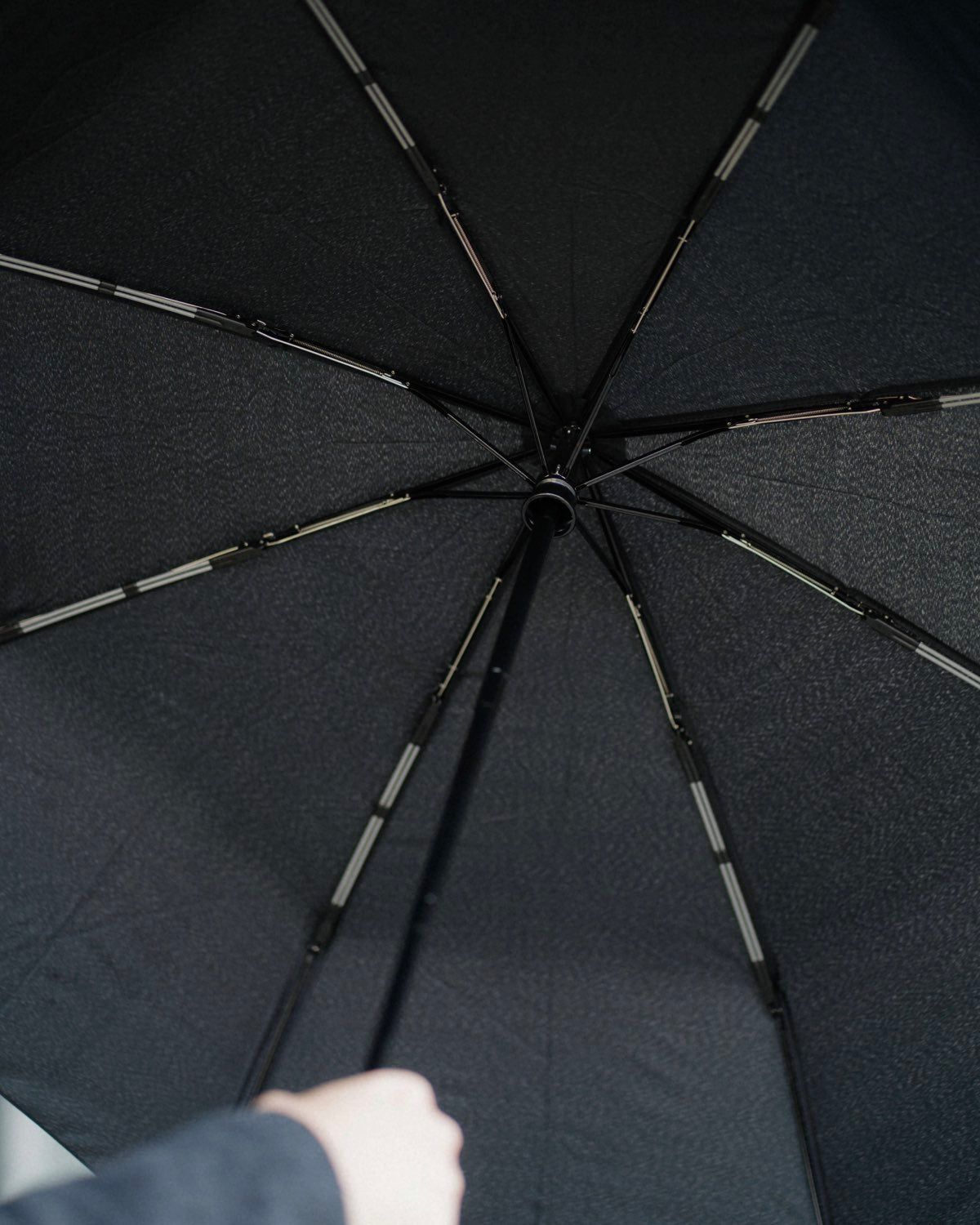
The outer ribs define the shape of the canopy. Stretchers connect them to the moving runner and transmit the forces created during opening and under load. Their materials, cross-sections, lengths and arrangement jointly determine how the frame responds.
Joints and Attachment Points
An umbrella contains numerous moving connections. They must permit movement while transmitting the forces acting upon them. The points at which the canopy is attached to the frame are part of the same system.
Shaft and Mechanism
The shaft stabilises the central axis of the umbrella. A folding umbrella uses several telescopic sections, while a full-length umbrella has a continuous shaft. Each form places different demands on construction, weight and movement.
Canopy and Fabric Tension
The canopy is not a passive covering. Its cut, seams, tension and attachment determine how air moves across the surface and how forces are transferred to the frame. Even tension matters as much as the fabric itself.
Handle and Balance
The connection to the hand also plays a role. A secure handle and balanced construction make it easier to orient and control the umbrella. They do not make it stormproof, but they influence its behaviour in changing weather.


The Role of Fibreglass Ribs
Fibreglass combines structural stability with a degree of flexibility. Under pressure, fibreglass ribs can yield in a controlled manner rather than immediately bending permanently. After a moderate load, they can return to their original form.
Their quality only becomes meaningful in combination with the remaining components. The shaft, joints, stretchers, canopy and attachment points must be designed as a coherent system. A high-quality material cannot compensate for an unbalanced construction on its own.
A greater number of ribs does not automatically mean greater wind resistance either. Additional ribs can divide the canopy more evenly and distribute pressure across more points. At the same time, they add weight and structural complexity. The execution of the complete frame remains decisive.


Is an Inverted Folding Umbrella Damaged?
A strong gust can turn the canopy of a flexible folding umbrella inside out. This can appear dramatic, but it does not necessarily mean that the umbrella is defective.
By inverting, the frame may release part of the load acting upon it. What matters is how the umbrella is handled afterwards:
-
Do not force the canopy back against the wind.
-
Move to a sheltered place if possible.
-
Close the canopy using its intended mechanism.
-
Check the ribs, fabric, shaft and joints for visible damage.
-
Do not bend distorted ribs back by hand.
If components are broken or permanently bent, the mechanism is blocked or sharp parts are exposed, the umbrella should no longer be used.
How to Hold an Umbrella in Wind
Even the most considered construction can only operate within its physical limits. Appropriate handling reduces unnecessary strain:
-
Keep the convex outer side of the canopy facing the wind wherever possible.
-
Do not force the umbrella to remain open against a strong gust.
-
Seek shelter early when wind direction changes rapidly.
-
Keep the umbrella closed during storms, thunderstorms or extreme gusts.
-
Inspect the frame and mechanism after an unusually strong load.
The umbrella should be allowed to move with the wind rather than being held as a rigid surface against it.
How Sapor Approaches Stability
At Sapor, we consider resilience a property of the complete construction. Our umbrellas use fibreglass ribs that combine stability with controlled flexibility. Depending on the model, they are paired with an aluminium or steel shaft and different opening mechanisms.
The Sapor Essential spans its canopy across eight ribs. The Sapor Iconic uses ten fibreglass ribs to divide the canopy into ten narrow fabric panels. They define both the construction and the model’s finely segmented silhouette.
We do not derive an unlimited wind claim from the number of ribs. Even a carefully constructed umbrella should remain closed during storms and extreme gusts.
Acknowledging that limit does not contradict our standard of quality. It is part of it. A good product is not defined by the largest possible claim, but by considered construction, clear guidance and a reliable response when problems occur.
A Good Umbrella Works With the Weather
An umbrella does not need to be unyielding in order to be resilient. It needs to distribute forces, allow controlled movement and remain safe to operate.
Stability does not come from one material or from the word “stormproof”. It emerges from the relationship between frame, shaft, mechanism, canopy and use.
A good umbrella does not promise to defeat every kind of weather. It is designed to fulfil its intended purpose reliably over time — within the limits set by wind and construction.
Embrace the rain.